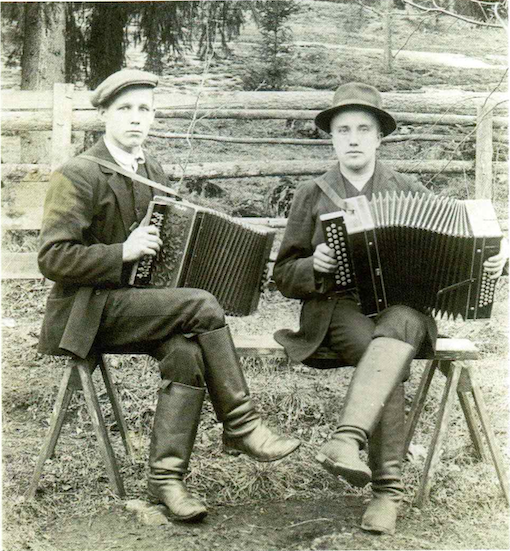
The project Arrangements from Einar Odell’s Repertoire began when I heard that the Karkkila Museum had received two well-preserved music notebooks from the early 20th century as a donation. The notebooks had been written by Einar Odell (1893–1971), an accordionist from Karkkila.
For several years, I had been wondering whether there might be any folk music collected in Karkkila that I could include in the programme of Fagerkulla Folk, the festival I organise. Apart from a few tunes I happened to come across in sheet music collections from the Uusimaa region, however, I had not been able to find any material.
After moving to Western Uusimaa in 2020, I became interested in the local pelimanni music tradition. There is a wealth of material from the Lohja and Nummi areas, and several collections of sheet music had already been compiled, making it easy to explore. There was also plenty of information available about the pelimannit—traditional folk musicians—who were active in the area around the turn of the 20th century. Finding information about musicians from Karkkila itself proved much more difficult, even though Karkkila is just next door.
I was therefore incredibly excited to hear that the tunes notated by Einar Odell had found their way back to Karkkila. One of the notebooks is dated 8 February 1915, and I concluded that the other, undated notebook must be written just before the dated one. The notebooks immediately raised many questions. Who was Einar Odell? How and where had he learned to play music and read and write musical notation? How had he chosen these particular tunes, and who did he play with?
I found some answers in an article written by Pekka Wikberg and published by the Karkkila Local Heritage Association (issue 49/2023, p. 10). According to the article, the Odell family lived in Haukkamäki. Their house was near Haukkamäki School and had been built by Einar’s father, Kustaa Adolf Odell, who worked as a factory foreman around the turn of the century. Einar also spent his working life at the factory, eventually becoming head of the purification plant. The entire family is said to have been musical.
The tunes in Odell’s notebooks were predominantly dance tunes that were also popular in Lohja around the same time, particularly polkas and waltzes. The notebooks also contain mazurkas, a polka mazurka, a couple of schottisch, saksanpolkka (translates “german polka”), a march, and a tune titled “Krakoviak”—a dance also known locally as rakojaakko. In addition, Odell notated one polska under the title “Polska från Wermland”.
As part of my project, I am transcribing Odell’s tunes into clean notation and arranging them for different pelimanni ensemble formations. My aim is to bring these tunes back into active use by creating arrangements that musicians can easily join in and play together.
Anyone interested in the project is warmly welcome to explore the tunes and arrangements at a folk music camp in Karkkila in July 2027, during week 29 (19–23 July). Participants need only a basic ability to play an instrument.
The week will culminate in a concert at Pakari, part of the Karkkila-Högfors Workers’ Museum, on Saturday 24 July, as part of Fagerkulla Folk. More details about the camp will be announced in spring 2027, but you can already save the dates!
My heartfelt thanks go to the TTA Foundation and the Finnish Music Foundation (Musiikinedistämissäätiö), whose support makes it possible for me to work with Odell’s music notebooks and create new arrangements.
Photo accompanying the article: Accordionists Yrjö Friman and Einar Odell in 1914. KRS.